




I am Dr. Surej, Consultant Physician, MD in Ayurveda at Ayur Bethaniya Ayurvedic Hospital in Kerala
Back pain is one of the most common complaints I encounter in my clinical practice. I see patients with very different reasons for experiencing it—some spend long hours sitting at a desk, some have age-related changes in the spine, while others come with muscular stiffness, recurring pain or restricted movement.
Since the reasons for back pain vary, I don't prescribe the same treatment for all my patients. First, I examine the site and type of pain, its duration, related symptoms, and the state of my patient's health. If needed, I can apply Kati Vasti as the local therapy.
What Is Kati Vasti for Back Pain, Its Benefits and Procedure is the topic that my patients often address to me, especially if they seek an alternative approach to treating their back pain.
Kati Vasti For Back Pain – What Is It, Benefits and How To Do It is a question that I have been asked several times by my patients, especially those seeking an alternative treatment option for their chronic back pain.
What Is Kati Vasti?
Kati Vasti is a local Ayurvedic treatment done over the area of the lower back. Kati means lower back while Vasti means retaining something in a certain area.
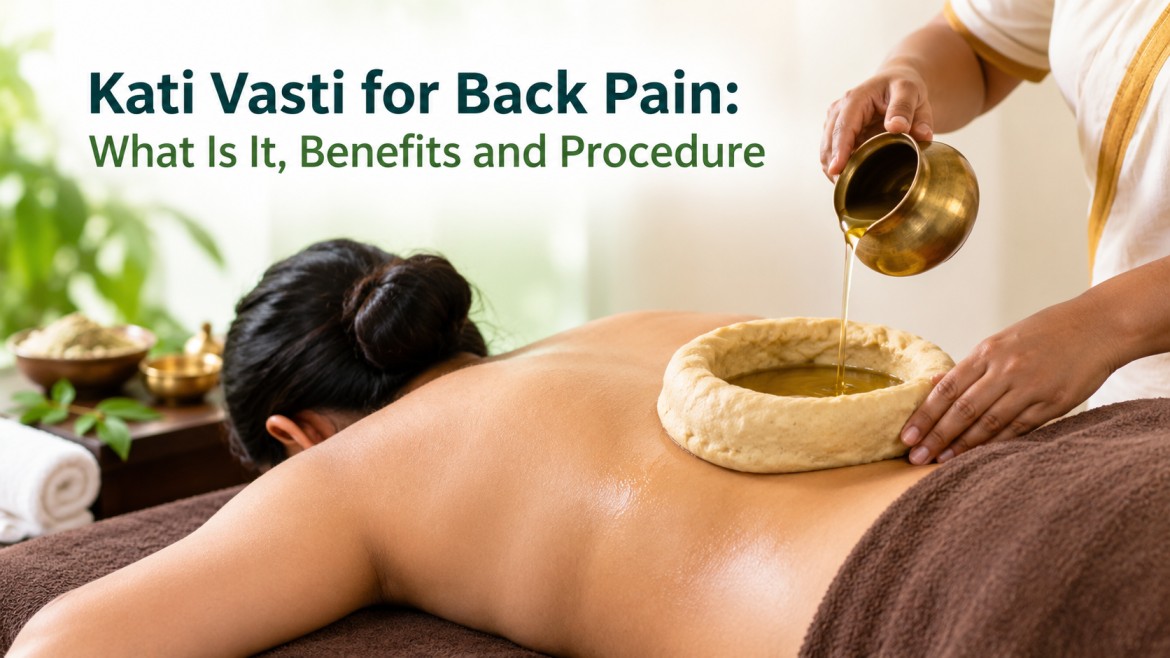
In the process of doing Kati Vasti, a dough ring is applied on the area of the lower back and creates an enclosure. Warm medicinal oil is then poured onto the enclosure.
The warmth of the oil and prolonged local application are central aspects of the procedure. The specific oil used is selected according to the patient's condition and the Ayurvedic physician's assessment. Kati Vasti is traditionally used in the management of certain pain and stiffness-related musculoskeletal conditions.
From my perspective, however, the procedure should never be selected simply because a patient has "back pain." Understanding the underlying problem is the first step.
Why Is Kati Vasti Considered for Back Pain?
In Ayurveda, the lower-back region is closely associated with Vata. Pain, stiffness, restricted movement and certain musculoskeletal complaints may be assessed in the context of Vata imbalance.
Warm oil therapies are traditionally used when features such as dryness, stiffness and pain are prominent. Kati Vasti provides localized warmth and oleation over the affected region.
I generally consider it as one component of treatment rather than an isolated solution. Depending on the patient's condition, it may be combined with other Ayurvedic therapies, physiotherapy, exercises, dietary modifications or lifestyle changes.
What Are the Benefits of Kati Vasti?
The benefits can differ from one patient to another. I prefer to explain them as potential therapeutic benefits rather than making a guaranteed claim.
1. May Help Relieve Lower-Back Discomfort
The application of warm medicated oil over the lower back can have a soothing effect. In appropriate patients, this may help reduce the experience of localized discomfort.
2. Can Assist with Stiffness
Those with stiffness in the lumbar area will be likely to find the heat very soothing. It could be included in a holistic treatment regimen intended to promote increased flexibility.
3. Provides Local Heat Therapy
A good thing about Kati Vasti is the fact that the heat is provided specifically for the lumbar region. In this way, it is possible to apply treatment only to a certain area.
4. Helps in Local Oleation
Oleation is a crucial principle of Ayurvedic treatment. Depending on the health problems of the person, local oleation could be applied when there are indications of Vata imbalance, like dryness and stiffness.
5. Can Contribute to Relaxation
The heating and calm atmosphere during the procedure will most likely be relaxing for some patients. They may feel relaxed in the treated area after the procedure.
6. Can Be Part of a Broader Treatment Programme
In my practice, I rarely look at Kati Vasti in isolation. If a patient has recurring back pain, I also consider posture, physical activity, muscle strength, sleep, occupation and other factors that may contribute to the problem.
Kati Vasti Procedure: What Happens During Treatment?
Even though Kati Vasti is a fairly simple technique, I advise that it should be done under the guidance of an experienced practitioner of Ayurveda.
Step 1: Clinical Assessment
Prior to any ayurvedic treatment, I conduct a clinical assessment of the patient.
I normally enquire about:
- Location of the pain
- Duration of the pain
- Whether it is a constant or intermittent pain
- If the pain radiates down to the legs
- Numbness or tingling
- Weakness of the muscles
- Previous injuries or trauma
- Past spinal treatments or surgeries
- Other health issues
- Any previous tests like X-ray, MRI etc.
It helps me in determining whether Kati Vasti treatment is suitable for the individual in the specific condition.
Step 2: Preparation of the Patient
The patient is put in a position where his/her lower-back area can be accessed easily. The site is prepared before putting on the dough ring.
Step 3: Forming the Dough Ring for Kati Vasti Treatment
A dough ring is put on the affected part. This dough must be securely held on the skin in order to ensure that there is no leakage of oil.
Step 4: Filling with Warm Medicinal Oil
The required medicinal oil is warmed up to a comfortable temperature. This is done before it is poured on the sealed site.
The temperature matters much when it comes to this step. The oil should neither be too cold nor too hot.
Step 5: Retaining the Oil
Warm oil is retained in the dough ring throughout the time set by the doctor.
In this phase, I consider the patient's comfort and the temperature of the oil. It may need to be changed if needed.
Step 6: Performing the Procedure
When the time allotted by the prescription ends, the oil is washed off, and the ring is taken off.
Based on the treatment regimen, further steps for the patient would depend on whether he has to rest or perform another procedure.
How Long Does It Take to Perform a Kati Vasti?
It is difficult to say the exact time of the Kati Vasti session because the length depends on the state of a patient and the therapeutic plan. There is no standard length of procedure suitable for all cases.
Also, the number of the sessions is not fixed. The schedule of the sessions is chosen by me after I evaluate the condition of a patient and his/her reaction to therapy.
Who Can Benefit from Kati Vasti?
Kati Vasti may be prescribed to certain patients with back pain and other musculoskeletal problems.
In Ayurvedic practice, it may be incorporated into management plans for conditions associated with Vata and the lower-back region.
However, suitability depends on the individual.
A patient with mild muscular stiffness may require a very different approach from someone with a diagnosed disc problem, nerve compression or significant spinal degeneration.
That is why I do not recommend Kati Vasti based on symptoms alone.
Is Kati Vasti Suitable for All Back Pain?
No. It is an important point to note.
Reasons for back pain can range from muscle strain, poor posture, degeneration, disc problems, nerve compression, injuries or certain systemic conditions.
There are some signs which require medical intervention but not Ayurvedic management.
For example, severe or progressive weakness, significant numbness, loss of bladder or bowel control, unexplained weight loss, fever accompanying back pain, or severe pain following trauma should be evaluated medically.
If a patient already has an MRI, X-ray or specialist diagnosis, I consider those findings while planning Ayurvedic care.
Kati Vasti Alongside Physiotherapy and Exercise
One of the mistakes I see in the management of chronic back pain is focusing entirely on passive treatments.
Although a therapy like Kati Vasti can provide comfort and relief from stiffness for the right kind of patient, good back health may depend on action too.
Based on the specific situation of the patient, I may recommend:
- Stretching properly
- Exercises
- Physiotherapy
- Improving posture
- Ergonomics
- Weight loss if required
- Physical exercise
- Enough sleep
At Ayur Bethaniya, physiotherapy and rehabilitation can be adopted where applicable, thus allowing therapy to treat both the symptoms and the functional restrictions.
What Can I Anticipate After Kati Vasti?
One can expect a sensation of warmth and relaxation right after the treatment. There may be a temporary reduction of stiffness and pain in some cases.
However, the response is individual. I do not tell patients that one session will necessarily resolve chronic back pain.
If the underlying cause involves posture, muscle weakness, degenerative changes, or another structural problem, I still need to address those factors.
This is why I view Kati Vasti as part of an individualised treatment plan rather than as a standalone cure.
Is There Anything to be Precautious About?
The Kati Vasti treatment should be conducted after proper analysis. The treatment may not be right for all cases and precaution may be necessary for certain individuals.
Patients with significant skin problems in the treatment area, acute infections, certain inflammatory conditions or other medical concerns should be assessed before undergoing the procedure.
I also advise patients not to self-administer the treatment at home simply by following an online description. Correct temperature, appropriate oil selection, positioning and clinical assessment all matter.
My Approach to Back Pain as an Ayurvedic Physician
When a patient consults me for back pain, I start by asking a simple question: Why is this person experiencing the pain?
Only after understanding the likely cause do I consider which therapies may be useful.
From an Ayurvedic perspective, I assess factors such as Prakriti, Vikriti, Dosha involvement, Agni, lifestyle and the nature of the pain. At the same time, I consider relevant modern medical investigations and diagnoses.
If Kati Vasti is appropriate, I may include it as part of the treatment programme. If the patient requires physiotherapy, further investigation or specialist medical care, those aspects are also addressed.
For me, good Ayurvedic treatment is not about applying the same therapy to everyone. It is about selecting the right intervention for the right patient at the right stage.
Kati Vasti for Back Pain: What Is It, Benefits and Procedure – A Practical Perspective
Kati Vasti is an indigenous Ayurvedic procedure involving the retention of warm medicated oil on the lumbar region of the back. The treatment is usually used for certain instances of back pain and stiffness, among others.
The possible advantages associated with the use of this therapy include local warming and relief for pain and stiffness. But whether there would be any effect or not will depend on the cause of the back problem and the state of health of the person.
It is my advice for patients to have a medical check-up before commencing treatment. Where it is appropriate, the therapy can be combined with other treatments such as physiotherapy and exercises.
Ayur Bethaniya: Leading Ayurvedic Hospital in Kerala
In Ayur Bethaniya, I adopt a customised method of practice for my patients based on their physical and medical condition along with their symptoms. Ayur Bethaniya offers Ayurvedic therapies as well as panchakarma, physiotherapy and rehabilitation, yoga and meditation, and also other medical treatments. This multidisciplinary approach can prove helpful for those suffering from chronic issues of the musculoskeletal system that need multiple treatments. To know more about our services and facilities, please visit Ayur Bethaniya.
Read to know: How Panchakarma Restores Balance in Modern Lifestyles
